How does energy surplus size impact muscle hypertrophy in experienced lifters?
For resistance-trained lifters, the optimal energy surplus for muscle hypertrophy is 5% above daily maintenance expenditure, or roughly 125 to 200 kcal/day. Research shows a 15% surplus increases fat mass accretion fourfold without accelerating fractional muscle protein synthesis or lean mass gains compared to a conservative 5% intake.
Unseasoned lifters display heightened sensitivity to resistance training, converting high energy surpluses into muscle tissue through rapid myofibrillar accretion. Experienced lifters face physiological limits in fractional synthetic rate responses. Surplus energy consumed beyond this adaptation ceiling routes straight to adipose tissue rather than contractile protein synthesis.
In a four-week parallel-groups trial published on ResearchGate, resistance-trained subjects assigned to a 15% surplus gained identical muscle cross-sectional area and strength to those on a 5% surplus. The 15% cohort accumulated substantially more subcutaneous fat across every measured skinfold site.
Establishing a precise hypercaloric target starts with establishing an accurate maintenance baseline. You can calculate your current caloric baseline using our TDEE Calculator. A lifter with a baseline expenditure of 3,000 kcal/day needs a 150 kcal/day intake shift to hit a 5% target, whereas a 15% surplus demands 450 kcal/day, adding 300 kcal of unneeded energy daily.
Does a 15 percent caloric surplus build more muscle than a 5 percent surplus?
Hypertrophic signaling in trained muscle is governed by mechanical tension and intracellular kinase pathways like mTORC1 rather than excessive calorie availability. Once daily muscle protein synthesis saturates through adequate energy and 1.6 to 2.2 g/kg of daily protein, additional energy intake fails to increase ribosomal biogenesis or myofibrillar growth.
A systematic review indexed in PubMed Central demonstrated that scale weight gain exceeding 1.0% of total body mass per month skews nutrient partitioning heavily toward adipose storage in trained populations. Restricting target body weight velocity between 0.5% and 1.0% per month maximizes skeletal muscle growth while capping body fat accumulation.
Experimental findings from the Victoria University Research Repository show that hypercaloric intake above metabolic requirements does not increase nitrogen retention in trained athletes. Localized mechanical strain and intrinsic protein turnover limits regulate muscular growth, not raw calorie volume.
Nutrient partitioning also depends heavily on protein distribution throughout the daily feeding window. Athletes maintain optimal protein synthesis by managing meal timing as outlined in our guide on optimal protein timing for maximum muscle hypertrophy. Consuming 0.40 to 0.55 g/kg of protein per meal across four to five feedings keeps blood leucine concentrations elevated without requiring an aggressive calorie surplus.

What is the relationship between surplus magnitude and fat accumulation?
Adipose tissue expansion accelerates when daily energy intake exceeds the rate of myofibrillar protein synthesis. At a 5% energy surplus, the partitioning ratio remains favorable, directing most scale mass gain into skeletal muscle tissue. Increasing the surplus to 15% degrades this ratio, shifting up to 80% of added weight into fat storage.
Consider an 80 kg athlete completing a 16-week massing block. A 150 kcal/day surplus yields roughly 1.36 kg of total scale mass, comprised of 0.95 kg of skeletal muscle and 0.41 kg of fat mass. Pushing that surplus to 450 kcal/day generates 4.08 kg of scale weight, yielding an identical 1.00 kg of muscle while adding 3.08 kg of fat mass.
Accumulating unnecessary adipose tissue reduces total yearly training time spent in a lean bulking state. Stripping 3.08 kg of body fat demands a subsequent 7 to 10 week cutting block at a -500 kcal/day deficit. Conversely, a 5% surplus requires minimal post-massing dieting, as explored in our framework to Calculate Protein via Fat-Free Mass to Retain Lean Muscle.
Parameter / Outcome Metric | Conservative Surplus (5%) | Aggressive Surplus (15%) |
|---|---|---|
Monthly Target Weight Gain Velocity | 0.5% – 1.0% total body weight | 1.5% – 2.5% total body weight |
Nutrient Partitioning Ratio (P-Ratio) | 70% Lean Mass / 30% Fat Mass | 25% Lean Mass / 75% Fat Mass |
Estimated 16-Week Adipose Accretion (80 kg lifter) | ~0.41 kg fat mass | ~3.08 kg fat mass |
Caloric Cost per 1.0 kg Muscle Gained | ~16,800 total surplus kcal | ~50,400 total surplus kcal |
Glycogen Resynthesis Optimization | Fully Saturated | Fully Saturated (Spillover to Lipogenesis) |
Subsequent Cutting Phase Required | 1 – 2 weeks at -300 kcal/day | 7 – 10 weeks at -500 kcal/day |

How to calculate and execute a 5 percent lean bulking caloric surplus
Executing a 5% surplus requires strict nutritional tracking because a 125 to 200 kcal daily buffer leaves zero room for error. Standard tracking errors easily wipe out or double this margin if daily food measurement lacks precision. Athletes can calculate exact baseline macro splits using our Macro Calculator.
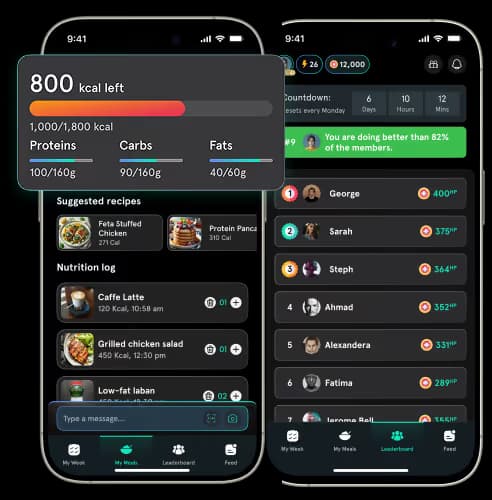
Hitting exact hypercaloric targets requires consistent logging of meal metrics and daily macros. Athletes can maintain precise dietary control by using meal logging by photo, chat or manual entry to log intake accurately. Monitoring ongoing energy trends using a weekly nutrition summary and meal history prevents untracked calorie creep from inflating fat gains.
Carbohydrates should supply the majority of surplus calories to optimize glycogen resynthesis and fuel training output. High muscle glycogen availability prevents power drop-offs during heavy compound sets. Advanced lifters should target 4.0 to 7.0 g/kg of daily carbohydrates during massing cycles to sustain high training volume.
How training stimulus impacts energy surplus utilization in trained lifters
Surplus energy only converts into functional contractile tissue when resistance training delivers an adequate mechanical tension stimulus. Without sufficient proximity to failure, even a modest 5% energy surplus results in unwanted fat accumulation. Trained athletes must push working sets to within 1 to 3 repetitions in reserve, as detailed in our guide on how to set repetitions in reserve for muscle hypertrophy.
Analysis published in MDPI Sports confirms that advanced athletes who systematically apply progressive overload direct surplus energy toward muscular repair rather than lipid storage. Progressive overload ensures that the extra 125 to 200 kcal/day fuels myofibrillar remodeling.
Tracking exercise selection, weight progression, and working set volume across multi-week training blocks prevents plateauing. Lifters can monitor overload targets using guided gym workouts with set-by-set logging of reps, weight and assisted-machine loads to ensure training stress matches hypercaloric nutrition.
Frequently Asked Questions
What scale weight velocity confirms a true 5 percent caloric surplus?
A true 5% caloric surplus produces a monthly scale weight gain of 0.5% to 1.0% of total body weight. For an 80 kg athlete, this equals 0.4 to 0.8 kg per month. Weight velocity exceeding 1.5% per month indicates overshooting the calorie target and accelerating triglyceride storage in adipose tissue.
Should protein intake increase when transitioning from maintenance to a lean bulk?
No, protein requirements do not rise during a hypercaloric phase. Caloric surpluses are protein-sparing because dietary carbohydrates and fats meet energy demands. Maintaining 1.6 to 2.2 g/kg of daily protein supplies maximum amino acid availability for myofibrillar protein synthesis; additional protein is simply oxidized for energy.
How long should an advanced athlete maintain a conservative caloric surplus?
Advanced athletes can maintain a 5% surplus for 16 to 24 consecutive weeks. Because monthly fat accretion remains under 0.5 kg, lean hypercaloric phases can extend significantly longer than aggressive bulks before requiring a mini-cut, maximizing total time spent in a positive nitrogen balance.
How do carbohydrate fluctuations affect scale weight tracking during a hypercaloric phase?
Carbohydrate increases raise intramuscular glycogen stores, binding roughly 3 grams of water per gram of glycogen. Increasing carbohydrate intake by 200 grams can shift scale weight by nearly 0.8 kg within 48 hours without changing actual skeletal muscle tissue or fat mass.
Operating at a 5% caloric surplus requires coordinating precise daily calorie targets with accurate overload tracking in the gym. TrainMate provides the meal logging precision and workout tracking tools needed to direct every surplus calorie toward lean muscle accretion.