Does a 2-day carbohydrate refeed preserve fat-free mass better than a continuous deficit?
A 2-day carbohydrate refeed preserves fat-free mass during extended caloric deficits by restoring muscle glycogen, increasing circulating leptin, and suppressing muscle protein breakdown. Maintaining maintenance calories through high carbohydrate intake for 48 consecutive hours prevents adaptive thermogenesis far more effectively than continuous energy restriction while achieving identical net fat loss over a training block.
Resistance-trained athletes following a 2-day carbohydrate refeed retain 0.8 kg more dry lean mass over 7 weeks than those on continuous energy restriction under identical weekly caloric deficits. A 2020 randomized controlled trial published in the Journal of Functional Morphology and Kinesiology by Campbell and colleagues compared a continuous 25% energy deficit against an intermittent deficit featuring 5 days at a 35% deficit and 2 consecutive days at caloric maintenance using carbohydrates.
The continuous diet group lost an average of 1.2 kg of fat-free mass. The 2-day refeed group lost only 0.4 kg of fat-free mass, with the majority of that minor loss representing transient water and glycogen shifts rather than skeletal muscle tissue. A detailed review by Menno Henselmans on the Campbell refeed trial noted that muscle tissue loss was virtually eliminated when high carbohydrate intake coincided with resistance training.
Continuous energy restriction forces the body into prolonged low energy availability. Sustained energy deficits downregulate intracellular signaling pathways, specifically mammalian target of rapamycin complex 1 (mTORC1), while increasing muscle protein breakdown rates. Athletes dropping below critical energy thresholds risk severe muscle oxidation; reviewing the energy availability threshold for muscle preservation helps set safe baseline caloric floors.
Intracellular signaling shifts within 48 hours of restored energy intake. Phosphorylation of mTORC1 increases rapidly when carbohydrate ingestion triggers systemic insulin secretion alongside adequate essential amino acid availability. This hormonal shift halts nitrogen loss and switches skeletal muscle from catabolic oxidation back to structural protein synthesis.

How do consecutive carbohydrate refeed days prevent metabolic adaptation?
Metabolic adaptation is governed primarily by circulating leptin, active triiodothyronine (T3), and sympathetic nervous system tone. A single 24-hour refeed period provides insufficient time to reverse hypothalamic energy-sensing signals. A 48-hour carbohydrate refeed is required to produce sustained increases in serum leptin and upregulate hepatic deiodinase enzyme activity, which converts inactive thyroxine (T4) into active T3.
When daily energy intake drops, serum leptin concentrations decrease by 30% to 50% within the first 24 hours. This rapid decline occurs long before measurable body fat loss takes place. The central nervous system interprets low leptin as an energy deficit state, decreasing resting metabolic rate (RMR) and increasing hunger signals via neuropeptide Y (NPY) neurons in the hypothalamus.
A 2021 study published in Nutrients confirmed that intermittent energy restriction protocols incorporating consecutive refeed days maintain measured resting metabolic rate significantly closer to predicted baseline values than continuous restriction. Attenuating this metabolic decline allows athletes to continue burning fat without resorting to dangerously low caloric intakes later in a cut.
Refeed duration dictates hepatic glycogen restoration and endocrine recovery. High carbohydrate intake produces an insulin response that acutely inhibits systemic lipolysis and muscle proteolysis. Maintaining this high-carbohydrate environment across 48 consecutive hours fully saturates intramuscular glycogen stores, increasing concentration by 150 to 200 mmol/kg dry weight while restoring sarcoplasmic hydration.
Restored glycogen levels directly enhance training performance during subsequent deficit days. Athletes who enter heavy sessions with depleted glycogen experience premature neuromuscular fatigue and increased cortisol output. Consuming targeted carbohydrate sources like those outlined in pre-workout food strategies for sustained energy maximizes glycogen deposition during the 48-hour window.

How should macros be adjusted for a 2 day carb refeed protocol?
Macro distribution during a 2-day refeed requires deliberate target reallocation rather than hypercaloric free-eating. Total daily energy intake returns precisely to 100% of baseline maintenance expenditure for both refeed days. Establish your baseline expenditure with a TDEE calculator before altering macronutrient ratios.
Protein intake stays constant across both deficit and refeed phases to protect nitrogen balance. Target 2.6 g/kg of fat-free mass daily. Keep dietary fat low on refeed days—specifically 0.5 g/kg of total body weight, or roughly 10% to 15% of total caloric intake—to create maximum room for carbohydrates without surpassing maintenance calories.
Carbohydrates fill the remaining energy allowance, scaling to 5.0–8.0 g/kg of total body weight on refeed days. Keeping dietary fat capped at 0.5 g/kg forces the body to utilize incoming glucose for glycogen storage rather than de novo lipogenesis. Use a dedicated macro calculator to split your exact energy targets across deficit and refeed days.
Day Type | Daily Caloric Target | Protein Target | Carbohydrate Target | Fat Target |
|---|---|---|---|---|
Deficit Day (5x/week) | 65% of TDEE | 2.6 g/kg FFM | 2.0–3.0 g/kg total weight | 0.8 g/kg total weight |
Refeed Day (2x/week) | 100% of TDEE | 2.6 g/kg FFM | 5.0–8.0 g/kg total weight | 0.5 g/kg total weight |
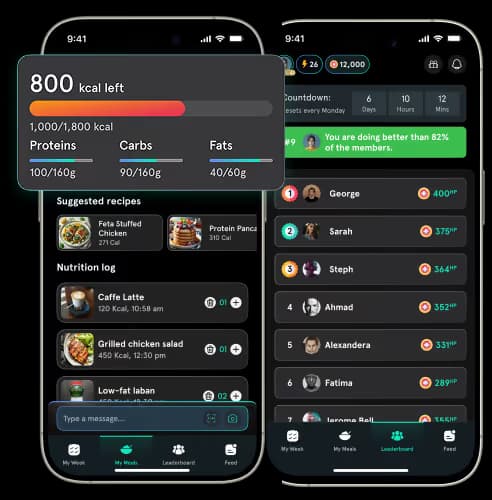
Managing alternating daily targets requires strict adherence to meal composition and volume. Tracking macro shifts across 5 deficit days and 2 refeed days is straightforward when utilizing meal logging by photo, chat or manual entry. Accurate tracking prevents accidental surpluses that compromise weekly fat loss goals.
What is the physiological difference between a carbohydrate refeed and a cheat day?
A carbohydrate refeed is a controlled, high-carbohydrate, low-fat nutritional intervention designed to equal maintenance energy expenditure. A cheat day is an ad-libitum, hypercaloric intake window high in both saturated fats and simple refined sugars.
These two approaches produce opposing metabolic outcomes. When large quantities of carbohydrate are consumed alongside minimal dietary fat, de novo lipogenesis accounts for less than 5% of fat synthesis in human adipose tissue under non-hypercaloric conditions. The enzymatic conversion of glucose into fatty acids is energetically inefficient, wasting approximately 25% of the carbohydrate energy as heat during conversion.
In contrast, pairing high carbohydrate loads with high dietary fat intake accelerates lipid storage. Insulin elevated by carbohydrate ingestion inhibits rate-limiting lipolytic enzymes, particularly hormone-sensitive lipase (HSL). Circulating dietary fats bypass de novo lipogenesis entirely and are stored directly in adipose tissue.
A systematic review on intermittent energy restriction in Molecular and Cellular Endocrinology demonstrated that unquantified hypercaloric feeding impairs net fat oxidation without offering metabolic benefits over structured maintenance refeeds. Building repeatable refeed meals in advance and saving them into a personal saved-meals library eliminates high-fat impulse additions during refeed days.
Evaluating overall intake patterns over multiple macro cycles using a weekly nutrition summary and meal history confirms whether your 5-day deficit accurately offsets your 2-day maintenance window. Consistent tracking ensures fat loss remains steady across the entire training phase.
Frequently Asked Questions
Can a single refeed day preserve muscle mass?
A single 24-hour refeed increases muscle glycogen slightly, but it fails to reverse adaptive thermogenesis or protect fat-free mass over an extended diet. Research confirms serum leptin and active T3 require at least 48 consecutive hours of caloric maintenance and high carbohydrate intake to achieve sustained hormonal recovery.
Should training volume increase on carbohydrate refeed days?
Training volume should not increase during refeed days. Schedule your highest-load training sessions—such as heavy lower-body squat or deadlift workouts—on the second refeed day or the day immediately following. This schedule uses fully saturated glycogen stores (up to 200 mmol/kg dry weight) for maximal force output.
Will a 2-day carb refeed cause sudden body weight gain?
Scale weight increases by 1.0 to 2.5 kg immediately after a 2-day carbohydrate refeed. This rapid change reflects intracellular fluid retention rather than body fat gain. Every gram of stored glycogen binds 3 to 4 grams of water, which flushes out within 48 hours of returning to the deficit.
How low should dietary fat be on refeed days?
Dietary fat should drop to 0.5 grams per kilogram of body weight, accounting for 10% to 15% of total caloric intake. Restricting fat intake prevents lipid storage while maximizing the available calorie budget for carbohydrate ingestion and muscle glycogen synthesis.
Structuring a 2-day carbohydrate refeed preserves lean mass, protects metabolic rate, and maintains training performance across deep cutting phases. Pairing precise macronutrient timing with progressive strength targets ensures cyclical energy availability translates directly into fat loss while retaining hard-won muscle. Logging your nutrition and training variables inside TrainMate keeps your energy expenditure and recovery capacity aligned every week of your cut.