A 2021 review in the Journal of Strength and Conditioning Research confirms that bodyweight training builds identical muscle mass to heavy lifting, provided you reach muscular failure. You do not need a fully equipped garage gym to force adaptation. Mastering progressive overload at home requires shifting your focus from the weight on the bar to the tension on the muscle. This guide breaks down exactly how to manipulate tempo, leverage, and rest periods to continuously trigger hypertrophy and strength gains from your living room.
Key Takeaways
- Control the tempo: Slowing the eccentric phase increases time under tension without adding physical plates.
- Manipulate leverage: Transitioning to unilateral exercises doubles the load on the working muscle.
- Slash rest periods: Reducing rest from 90 to 45 seconds drives metabolic stress, a primary driver of muscle growth.
- Expand range of motion: Using household items like books for deficit push-ups forces maximum muscle fiber recruitment.
- Track non-weight metrics: Consistency requires precise logging of sets, reps, and rep speed.
Table of Contents
- What is Progressive Overload at Home?
- 1. Slow Down the Tempo (Time Under Tension)
- 2. Shift to Unilateral Work
- 3. Decrease Rest Periods
- 4. Increase Range of Motion (ROM)
- 5. Push Closer to Failure (Reps in Reserve)
- How to Build Muscle at Home: A 4-Week Progression Checklist
- Frequently Asked Questions
- Conclusion & Next Steps
What is Progressive Overload at Home?
Applying progressive overload at home means systematically increasing the difficulty of your workouts over time using bodyweight and minimal equipment. Most people assume adding weight is the only way to progress, but mechanical tension and metabolic stress are the actual biological triggers for muscle growth. Mechanical tension occurs when muscle fibers stretch and contract under resistance, while metabolic stress is the accumulation of byproducts like lactate during sustained muscle contractions.
Key Insight: A 2017 meta-analysis by Dr. Brad Schoenfeld published in the Journal of Strength and Conditioning Research revealed that lifting loads as light as 30% of your 1-rep max stimulates equal hypertrophy to heavy lifting, provided sets are taken near failure. Gaining strength without a gym simply requires you to pull alternative levers like tempo and rest to replicate this intensity.
1. Slow Down the Tempo (Time Under Tension)
Changing the speed of your repetitions instantly increases difficulty and forces adaptation. Standard bodyweight squats might feel effortless by rep 15, but applying a 4-1-2-1 tempo drastically alters the stimulus. A 4-1-2-1 tempo dictates a 4-second descent, a 1-second pause at the bottom, a 2-second ascent, and a 1-second pause at the top. This prolonged time under tension forces your nervous system to recruit larger, fast-twitch muscle fibers earlier in the set.
A 2016 study in the Journal of Physiology found that slower eccentric phases produce significantly greater muscle protein synthesis than fast, uncontrolled drops. Implementing this home workout progression ensures you extract maximum value from basic movements. Controlling the eccentric phase physically damages the muscle fibers, which is essential for triggering the repair process that leads to growth.
2. Shift to Unilateral Work
Bilateral movements like standard push-ups distribute your body weight across two limbs. Shifting to unilateral, or single-limb, exercises effectively doubles the resistance without requiring external weights. If standard push-ups are too easy, elevate one hand on a basketball to shift 70% of the load to the working arm.
For the lower body, transition from standard bodyweight squats to Bulgarian split squats or pistol squats. The physics of unilateral training also engages core stabilizers to prevent rotational forces. You can effectively turn a 150-pound bodyweight into a significant unilateral load, seamlessly solving how to build muscle at home.
3. Decrease Rest Periods
Shortening the duration between sets forces your muscles to work while fatigued, driving massive metabolic stress. If you currently rest 90 seconds between sets of pull-ups, dropping that rest to 60 seconds forces immediate adaptation. Metabolic stress triggers cellular swelling and hormonal responses highly conducive to muscle growth.
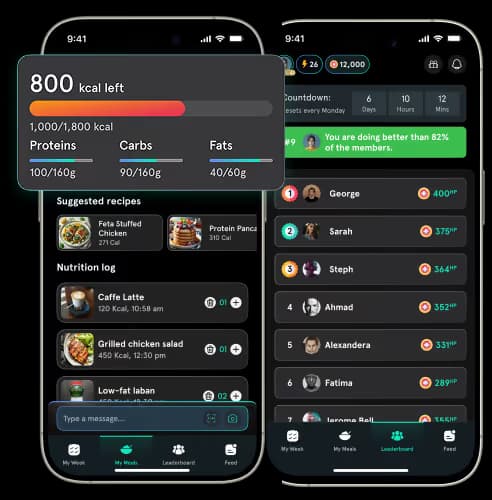
Managing these specific intervals prevents your body from fully clearing lactate, turning a basic routine into an intense hypertrophy session. Trainmate's workout logging tool tracks these exact metrics seamlessly, automatically calculating rest intervals so you hit the next set right at the 60-second mark. You can pair this precise timing methodology with insights from our guide on how to stay consistent with working out via habit stacking to build a robust daily routine.
4. Increase Range of Motion (ROM)
Expanding the physical distance a muscle travels during an exercise recruits deep muscle fibers that standard reps miss. A 2019 study published in SAGE Open Medicine confirmed that full range of motion training leads to vastly superior lower-body muscle hypertrophy compared to partial reps. At home, you can easily manipulate ROM using basic household items.
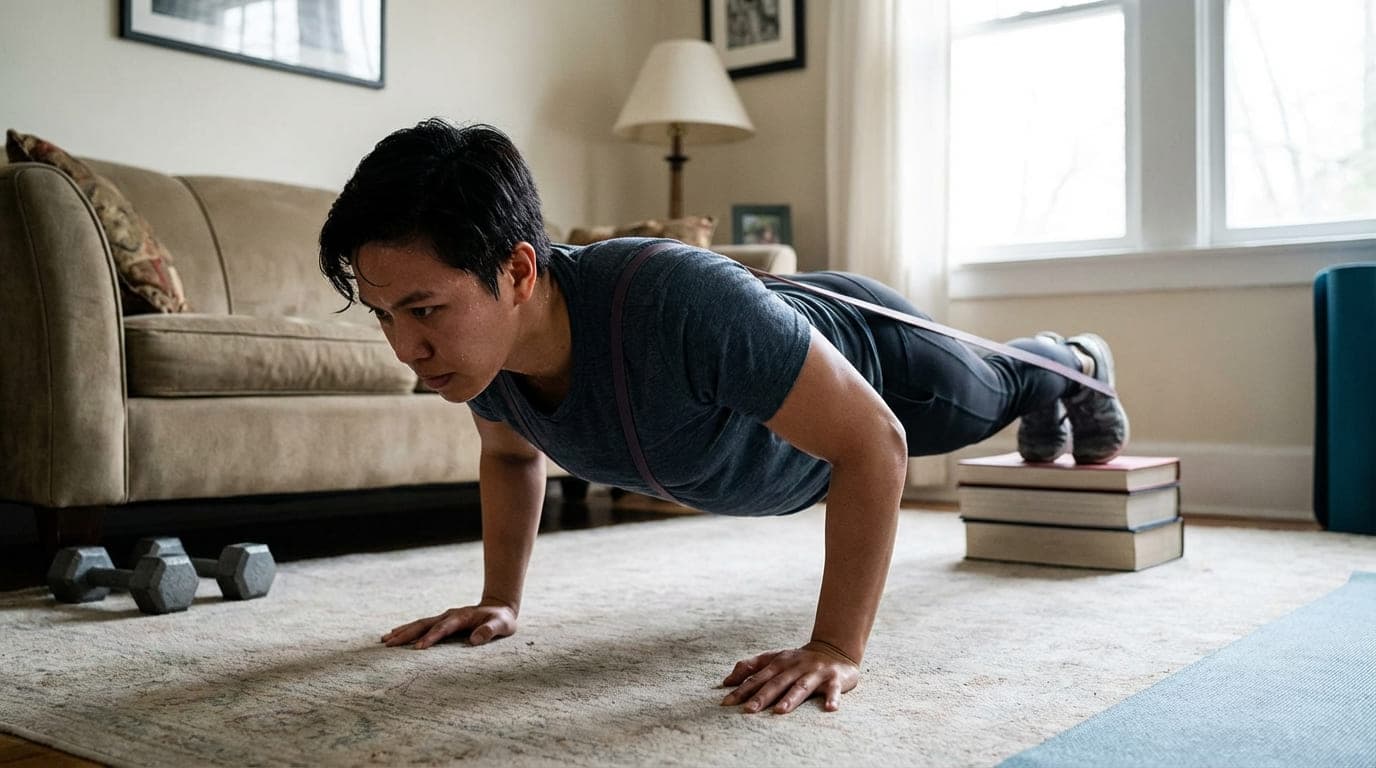
Place your hands on two thick books during push-ups to allow your chest to drop below parallel, or elevate your front foot during lunges to stretch the glute entirely. These deficit movements increase mechanical tension at long muscle lengths, a proven catalyst for muscle damage and subsequent repair. Combine these deeper stretches with proper nutrition found in our 7 best high-protein meal prep ideas to maximize recovery between sessions.
5. Push Closer to Failure (Reps in Reserve)
Bodyweight progressive overload relies heavily on proximity to failure. Reps in Reserve (RIR) measures how many more repetitions you could theoretically perform before absolute physical breakdown. To stimulate growth without heavy iron, your working sets must end with 0 to 2 RIR.
If you stop a set of 20 bodyweight squats but could have easily performed 30, you provided zero stimulus for growth. Pushing to near failure ensures full motor unit recruitment. High-rep sets are highly effective for hypertrophy, but only if the final repetitions are genuinely challenging. Tracking your RIR accurately prevents you from coasting through comfortable sets.
How to Build Muscle at Home: A 4-Week Progression Checklist
Implement these specific steps over a one-month mesocycle to guarantee continuous adaptation.
- Establish your baseline: Perform one set of push-ups, squats, and inverted rows to absolute failure. Log the exact number.
- Implement a strict tempo: During week two, reduce your total reps by 20% but apply a 3-second negative to every single repetition.
- Slash your rest periods: In week three, maintain the exact same volume and tempo from week two, but reduce rest between sets from 90 seconds to 60 seconds.
- Introduce a deficit: By week four, add books under your hands and feet to increase the range of motion by 2 inches for all primary pressing and squatting movements.
- Transition to single-limb variations: When deficit movements hit 15+ reps easily, shift to assisted one-arm push-ups and Bulgarian split squats.
Frequently Asked Questions
Can you actually build muscle with just bodyweight?
Yes. Muscle tissue responds to mechanical tension, not the specific origin of the resistance. Studies demonstrate that bodyweight exercises pushed to near muscular failure stimulate the exact same protein synthesis rates as barbell training. The key is manipulating tempo and leverage to maintain adequate tension on the target muscle groups.
How often should I increase the difficulty of home workouts?
You should attempt to progress a variable every single week. If you performed 3 sets of 15 push-ups last week, aim for 3 sets of 16 this week, or keep the reps at 15 but reduce the rest periods by 10 seconds. Micro-progressions force adaptation and prevent training plateaus entirely.
What is the ideal rep range for bodyweight progressive overload?
Research indicates hypertrophy occurs across a wide spectrum, anywhere from 5 to 35 repetitions. For home workouts, moderate-to-high rep ranges (12-25) are optimal. Once you exceed 35 repetitions in a single set, shift to a unilateral exercise or drastically slow your tempo to increase intensity without relying on marathon sets.
How do I track progressive overload without weights?
Log your total reps, sets, tempo, and rest periods meticulously. A set of 20 squats performed with a 3-second descent is entirely different from 20 fast, bouncing squats. Trainmate's workout plans capture these precise metrics, ensuring you accurately measure volume and intensity increases over time rather than just counting basic repetitions.
Do I need to train to failure on every set at home?
No. Training to absolute failure on every set causes disproportionate central nervous system fatigue and delays recovery. Aim to leave 1-2 reps in reserve for the majority of your working sets. Reserve absolute failure strictly for the final set of a specific exercise to safely maximize your muscle fiber recruitment.
Conclusion & Next Steps
Mastering progressive overload at home liberates you from the confines of a commercial gym. By deliberately manipulating your repetition tempo, expanding your range of motion, and adopting unilateral exercise variations, you create a limitless runway for muscle growth and strength gains. The next step is immediate implementation: pick one exercise you perform regularly and slow the eccentric phase to exactly three seconds during your next training session.
To guarantee consistent growth, you need to measure these new variables precisely. Use Trainmate's custom workout logging features to easily record rest intervals and rep tempos, ensuring your bodyweight progression stays on a scientifically sound trajectory. Track your next session directly in the app and watch the physical adaptations compound over the coming weeks.