Full Body vs Split Workouts: Which is Better for Building Muscle?
A 2016 meta-analysis published in Sports Medicine revealed that training a muscle group twice per week yields 3.1% greater hypertrophy than training it once. The debate between full body vs split workouts often ignores the most critical variable: your actual life schedule. This guide breaks down the time versus volume equation, helping you match your training split to your recovery capacity rather than rigid fitness dogma.
Key Takeaways
- Volume dictates growth: Total weekly sets matter more than how those sets are distributed across the week.
- Muscle protein synthesis dictates frequency: Intermediate lifters benefit from hitting muscles every 48 to 72 hours.
- Schedule dictates adherence: A 3-day full body routine you complete beats a 5-day split you constantly skip.
- Recovery dictates progress: Splitting muscle groups allows for higher per-session volume without causing systemic central nervous system fatigue.
Table of Contents
- The Science of Training Frequency for Hypertrophy
- Full Body Workouts: Maximizing Training Frequency
- Split Workouts: Targeting Volume and Recovery
- The Bro Split vs Full Body Debate
- Finding the Best Workout Routine for Muscle Gain Based on Your Schedule
- Practical Tool: Quick-Start Routine Selector
- Full Body vs Split Workouts FAQ
The Science of Training Frequency for Hypertrophy
The biological mechanism driving muscle growth is muscle protein synthesis. When you lift weights, you create micro-tears in the muscle fibers, which the body repairs by synthesizing new proteins. This anabolic window remains elevated for roughly 24 to 48 hours post-exercise in trained individuals. If you wait a full week to train that muscle again, you miss out on several potential growth cycles.
Key Insight: Muscle protein synthesis peaks 24 hours post-workout and returns to baseline within 36 to 48 hours for intermediate lifters, meaning higher frequency training leverages more growth spikes per week.
Understanding the numbers is crucial for optimizing your schedule. According to a 2019 review in the International Journal of Environmental Research and Public Health, total weekly volume dictates up to 70% of hypertrophy outcomes. Furthermore, a 2018 study in the Journal of Strength and Conditioning Research found that equating 15 weekly sets across 3 days versus 6 days produced identical muscle growth. Recent data from the CDC notes that only 23.2% of American adults meet both aerobic and muscle-strengthening guidelines, emphasizing that consistency and practical scheduling always beat optimal but unsustainable programming.
Full Body Workouts: Maximizing Training Frequency
Full body workouts involve training all major muscle groups—chest, back, legs, shoulders, and arms—in a single session. This approach typically requires performing one or two compound exercises per muscle group, such as squats, bench presses, and barbell rows, rather than isolating specific muscles. By repeating this process three times a week, you naturally increase your training frequency while maintaining moderate daily volume per muscle.
Advantages of Total Body Training
The primary advantage of a full body setup is the frequency of muscle stimulation. If you miss a workout on a Wednesday, your weekly volume is slightly reduced, but you are not skipping an entire muscle group for the week. This makes it an incredibly resilient routine for busy professionals. Additionally, because you are performing heavy compound lifts frequently, you experience high systemic energy expenditure, which can be advantageous for body composition and fat loss.
Disadvantages of Total Body Training
The main drawback is systemic fatigue. Performing heavy deadlifts, squats, and pressing movements in the same session taxes your central nervous system heavily. As you become more advanced and your strength increases, recovering from these all-encompassing sessions becomes difficult. You also have limited time and energy to focus on isolation movements, meaning smaller muscle groups like the lateral deltoids or calves might lag behind. This is where you need to carefully monitor how to optimize sleep for muscle recovery.
Split Workouts: Targeting Volume and Recovery
Split workouts divide your training across different days based on specific muscle groups or movement patterns. Common variations include Upper/Lower splits, Push/Pull/Legs (PPL), and the traditional body-part split. This structure allows lifters to accumulate high volume for specific muscles in one session while giving those muscles several days to recover before the next targeted session.
Advantages of Splitting Muscle Groups
Split routines allow for a much deeper focus on individual muscle groups. Because you are not training your entire body, you can dedicate 10 to 15 sets to your back or legs in a single day, driving immense localized metabolic stress and mechanical tension. This high per-session volume is excellent for advanced hypertrophy. Furthermore, split routines help manage central nervous system fatigue; a heavy leg day is exhausting, but an upper body day is significantly less taxing, allowing your nervous system to recover.
Disadvantages of Splitting Muscle Groups
The most significant risk with split training is missing a day. If you are following a 5-day body-part split and skip your dedicated back day, that muscle group receives zero stimulus for an entire week. Additionally, split routines often require a higher time commitment, demanding four to six days in the gym per week to hit every muscle group with adequate frequency. If you struggle to make it to the gym consistently, you may need to learn how to stay consistent with working out via habit stacking to stay on track.
The Bro Split vs Full Body Debate
A persistent argument in gym culture is the bro split vs full body debate. The bro split typically involves dedicating each day of the week to a single muscle group—for example, Chest on Monday, Back on Tuesday, Shoulders on Wednesday, Legs on Thursday, and Arms on Friday. While this has been popularized by professional bodybuilders, science paints a different picture for natural, intermediate lifters.
Natural lifters do not possess the pharmaceutically enhanced recovery and sustained muscle protein synthesis that advanced bodybuilders rely on. Therefore, destroying a muscle with 20 sets once a week often results in excessive muscle damage, known as junk volume, rather than productive growth. A full body or Upper/Lower split is almost always superior for natural trainees because it distributes the same 20 sets across two or three sessions, keeping the muscle protein synthesis signal elevated throughout the week without causing debilitating soreness.
Finding the Best Workout Routine for Muscle Gain Based on Your Schedule
Ultimately, the best workout routine for muscle gain is the one you can adhere to without compromising your recovery or your personal life. Volume is the primary driver of hypertrophy, and you can achieve the necessary 10 to 20 weekly sets per muscle group using almost any scheduling framework. The trick is matching the split to your available days.
Training 2 to 3 Days Per Week
If you can only commit to two or three sessions weekly, full body workouts are the undeniable winner. You simply do not have enough days to divide the body effectively while maintaining adequate frequency. Focus on heavy compound movements: squats, deadlifts, horizontal pushes, vertical pushes, horizontal pulls, and vertical pulls.
Training 4 Days Per Week
Four days is the sweet spot for an Upper/Lower split. You train your upper body on days one and three, and your lower body on days two and four. This provides an excellent balance of frequency, volume, and recovery. It allows you to push hard on specific areas while ensuring every muscle group is stimulated twice every seven days.
Training 5 to 6 Days Per Week
For those who genuinely enjoy being in the gym almost every day, a Push/Pull/Legs split run consecutively is incredibly effective. This split minimizes overlap and joint strain because pushing muscles (chest, triceps, anterior deltoids) have completely different recovery demands than pulling muscles (back, biceps, posterior deltoids).
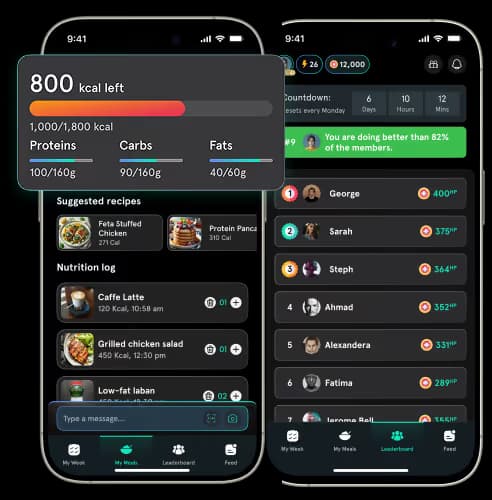
Theory is useless without practical application. If you are unsure which camp you fall into, try running a full body routine for 4 weeks, followed by an Upper/Lower split for 4 weeks. Trainmate's progressive overload tracker automatically logs your exact volume, sets, and reps, allowing you to objectively see which routine yields faster strength gains and better recovery for your specific body. Data always beats guesswork.
The Role of Progressive Overload Regardless of Split
Regardless of whether you choose full body vs split workouts, your routine will fail if you do not apply progressive overload. Progressive overload means continually increasing the demands on your musculoskeletal system to continually make gains in muscle size, strength, and endurance. This can be achieved by adding weight to the bar, performing more reps with the same weight, improving your lifting technique, or decreasing rest periods.
For beginners, linear progression—simply adding 5 pounds to the bar each week—is highly effective. Intermediates must be more strategic, often undulating their rep ranges to avoid plateaus. Whether you are in a commercial gym or tracking progressive overload at home, recording your lifts is non-negotiable. If you squat 225 pounds for 3 sets of 8 reps this week, you must aim for 3 sets of 9 reps next week.
Managing Central Nervous System (CNS) Fatigue
The central nervous system acts as the electrical grid for your muscles. When you perform highly taxing movements like heavy deadlifts or barbell squats, you are not just breaking down muscle tissue; you are draining the CNS. Full body routines inherently demand more from the CNS every single session because you are heavily loading the entire skeletal structure. In contrast, split routines give the CNS localized breaks. For instance, a bicep and tricep day on a split routine involves almost zero axial loading, allowing your spine and nervous system to recover while still stimulating muscle growth.
If you find yourself dreading the gym, struggling to sleep, or experiencing a sudden drop in grip strength, your CNS is likely overtaxed. This is a crucial metric when deciding between full body vs split workouts. If your life outside the gym is high-stress, a split routine with lower daily systemic fatigue might be the safer choice for long-term consistency.
Integrating Cardio with Your Lifting Routine
A common dilemma when structuring a weekly schedule is figuring out where cardiovascular training fits. If you are running a 3-day full body routine, you have four remaining days to easily program Zone 2 cardio or High-Intensity Interval Training without interfering with your weightlifting recovery. This makes full body routines excellent for overall athletic conditioning.
However, if you are running a 6-day Push/Pull/Legs split, adding cardio becomes a logistical challenge. Performing cardio immediately before lifting depletes glycogen and reduces the weight you can lift, blunting the hypertrophy stimulus. Therefore, lifters on high-frequency splits must either perform cardio post-workout or in a separate session entirely, which heavily increases the total time commitment required.
Advanced Techniques to Maximize Hypertrophy
Regardless of the overarching split, advanced lifters eventually need to employ intensity techniques to break through plateaus. Techniques such as drop sets, myo-reps, and rest-pause sets allow you to push a muscle far beyond its standard failure point.
Integrating these techniques differs vastly depending on your routine. On a split routine, you can safely deploy drop sets on your final exercise because that muscle group has several days to recover. Applying the same technique on a full body routine can be disastrous; destroying your quadriceps with drop sets on Monday will severely compromise your ability to squat heavy on Wednesday.
Nutrition: Fueling Your Chosen Frequency
Your training split dictates the stimulus, but your nutrition dictates the actual muscle gain. Training a muscle group twice a week requires a steady stream of amino acids to repair the damaged tissue. If you are under-eating protein or operating in a severe caloric deficit, a high-frequency full body routine may actually lead to muscle loss due to excessive breakdown without adequate repair.
Aim to consume roughly 0.7 to 1 gram of protein per pound of body weight daily. Distribute this protein evenly across four to five meals to maximize the muscle protein synthesis response. Carbohydrates are equally important, especially for intense Upper/Lower or PPL splits, as they replenish muscle glycogen stores depleted during high-volume sessions.
Practical Tool: Quick-Start Routine Selector
Use this checklist to build your weekly schedule efficiently:
- Assess your realistic availability: Be brutally honest about how many days you can train consistently every single week without failing.
- Select the framework: Choose full body for 2-3 days, Upper/Lower for 4 days, or Push/Pull/Legs for 5-6 days.
- Choose compound anchors: Pick one heavy compound movement (e.g., barbell squat, bench press) to start every single workout.
- Allocate accessory volume: Add 2-3 isolation exercises per session to target weaker or lagging body parts without frying your central nervous system.
- Track your baseline: Record your initial weights and reps for week one to establish the foundation for future progressive overload.
Full Body vs Split Workouts FAQ
Is it better to do full body or split workouts?
It depends entirely on your schedule. Full body is better for those training 2-3 days per week as it maximizes muscle protein synthesis frequency. Splits are better for those training 4 or more days, allowing higher per-session volume for individual muscles without causing extreme systemic fatigue.
Can you build muscle with just 3 full body workouts a week?
Yes. Training 3 days a week with a full body routine is highly effective for muscle gain. By hitting every muscle group three times weekly, you keep the anabolic signal elevated constantly. Just ensure you are applying progressive overload and eating in a slight caloric surplus.
Why is the bro split considered suboptimal?
The bro split trains each muscle only once every seven days. Because muscle protein synthesis returns to baseline within 48 hours for most lifters, the muscle spends five days doing nothing. A higher frequency approach splits that massive single-day volume into two days, stimulating growth twice.
How many sets per muscle group should I do per week?
Current sports science suggests that 10 to 20 sets per muscle group per week is the optimal range for hypertrophy. Beginners should start closer to 10 sets, while advanced lifters may need up to 20 sets to force adaptation. Quality and proximity to failure matter most.
Should beginners do full body or split workouts?
Beginners should almost always start with a 3-day full body routine. It allows them to practice complex compound movements more frequently, rapidly improving their neuromuscular coordination. It also builds foundational strength across the entire body before they require the high, localized volume of a split routine.
Conclusion
The debate over full body vs split workouts often misses the forest for the trees. Optimal muscle growth is driven by adequate weekly volume, mechanical tension, and consistent application over months and years. Your body does not know what day of the week it is; it only understands the stimulus it receives and the recovery it is granted.
Stop agonizing over the perfect routine and start executing a good routine flawlessly. Your specific next step is to look at your calendar, block out the days you can realistically commit to the gym, and select the corresponding split. Trainmate's workout plans feature can automatically build this structure for you, adapting the volume to your recovery data. Let the AI handle the math while you focus on lifting the weight.