How to Create a Custom Weekly Workout Plan for Muscle Gain
A 2022 systematic review published in Sports Medicine demonstrated that structured resistance training yields a 40% higher rate of muscle hypertrophy compared to randomized gym sessions. To build serious mass, you must execute a weekly workout plan for muscle gain that precisely balances mechanical tension, metabolic stress, and adequate recovery. This guide replaces guesswork with a scientifically backed micro-cycle tailored to your actual schedule. You will learn exact volume landmarks, optimal training frequencies, and how to select a split that guarantees consistent progress without causing central nervous system burnout.
Key Takeaways
- Target specific volumes: Aim for 10 to 20 working sets per muscle group every week for maximum hypertrophy.
- Train muscles frequently: Hit each major muscle group twice a week rather than using outdated single-muscle bro splits.
- Monitor your intensity: Keep 1 to 3 reps in reserve (RIR) on your working sets to ensure you push close enough to muscular failure.
- Align with your schedule: Choose a 3, 4, or 5-day split based on how many days you can realistically train consistently without missing sessions.
Table of Contents
- The Science Behind a Hypertrophy Training Program
- How to Structure a Workout Split Based on Your Schedule
- The 4-Day Upper/Lower Split Explained
- The 5-Day Push/Pull/Legs/Upper/Lower Hybrid
- Managing Volume and Frequency in Your Weekly Workout Plan for Muscle Gain
- Muscle Building Routine for Beginners: Translating Theory into Practice
- Optimizing Recovery and Sleep for Adaptation
- Quick-Start Implementation Checklist
- Frequently Asked Questions
The Science Behind a Hypertrophy Training Program
Hypertrophy requires consistent mechanical tension applied across multiple resistance training sessions per week. A landmark 2016 meta-analysis published in the Journal of Sports Sciences demonstrated that training a specific muscle group twice per week is significantly superior to training it once per week for maximizing muscle growth. Structuring your sessions to hit this twice-weekly frequency ensures you keep muscle protein synthesis elevated continuously, giving your body a constant signal to build new tissue.
Key Insight: The American College of Sports Medicine (ACSM) establishes that 10 to 20 hard working sets per muscle group per week serves as the optimal volume threshold for driving hypertrophic adaptations in intermediate and advanced lifters.
Building mass is an active biological process that requires forcing the muscle fibers to adapt to progressively heavier loads. You must apply systemic stress through compound movements, isolate specific heads of the muscle through targeted exercises, and supply the necessary caloric surplus to fuel the rebuilding process. Failing to coordinate these three variables mathematically guarantees stagnation, regardless of your effort level during individual gym visits.
How to Structure a Workout Split Based on Your Schedule
A training split dictates how you distribute your weekly volume across different days to balance localized muscle stimulation with systemic recovery. Selecting the correct schedule depends entirely on how many days you can realistically commit to the gym without missing sessions over a three-month period. Consistency dictates your long-term progress, making an adherence-friendly 3-day routine mathematically superior to a 6-day routine that you skip constantly due to time constraints.
The goal is to map your physical capabilities to the specific days you have available. If you work long hours on weekdays, concentrating your volume on the weekends and two targeted weekdays will yield the best results. Designing an effective split ensures that when you train your chest and shoulders on Monday, those tissues have fully recovered and remodeled before you subject them to heavy loads again on Thursday.
The 4-Day Upper/Lower Split Explained
The 4-day upper/lower split neatly divides the body into upper body musculature and lower body musculature across four weekly sessions. This format allows you to train four days per week while hitting every muscle group twice, perfectly aligning with the scientific literature on optimal hypertrophy frequency. A standard configuration involves performing Upper on Monday, Lower on Tuesday, resting Wednesday, and repeating the Upper and Lower sessions on Thursday and Friday.
An upper body session typically requires horizontal pressing, vertical pressing, horizontal pulling, and vertical pulling movements to ensure balanced development. A lower body session targets your quadriceps, hamstrings, glutes, and calves through heavy squats, hip hinges, and isolated machine work. Implementing this specific split effectively allows you to master progressive overload because you train movements frequently enough to improve neurological efficiency and motor control.
The 5-Day Push/Pull/Legs/Upper/Lower Hybrid
For lifters with high recovery capacities and five days available, combining a Push/Pull/Legs (PPL) split with an Upper/Lower split provides an elite framework for muscle growth. This 5-day split dedicates three days to specific movement patterns (Push, Pull, Legs) and two days to broader regional training (Upper, Lower). This structure allows you to allocate additional weekly sets to lagging body parts without extending individual sessions past the 75-minute mark.
You begin the week with a Push day targeting chest, shoulders, and triceps, followed by a Pull day for back and biceps, and a dedicated Leg day. After a rest day, you consolidate your secondary volume into one Upper day and one Lower day. This specific weekly workout plan for muscle gain prevents joint overuse injuries because it constantly varies the angles and intensities applied to your skeletal system throughout the micro-cycle.
Managing Volume and Frequency in Your Weekly Workout Plan for Muscle Gain
Training volume acts as the primary driver for cellular adaptation provided that your mechanical tension remains adequate during each set. A 2023 demographic study by the International Health, Racquet & Sportsclub Association (IHRSA) reported that 62% of gym-goers fail to see noticeable visual results due to program hopping without systematically tracking their volume. Furthermore, a 2021 cross-sectional study indicated that lifters following structured, volume-tracked macro-cycles increased their lean body mass by 2.4 kilograms over 12 weeks, compared to just 0.9 kilograms for intuitive trainers. Data from the Centers for Disease Control and Prevention (CDC) reinforces that structured muscle-strengthening activities are essential for long-term metabolic health and functional longevity.
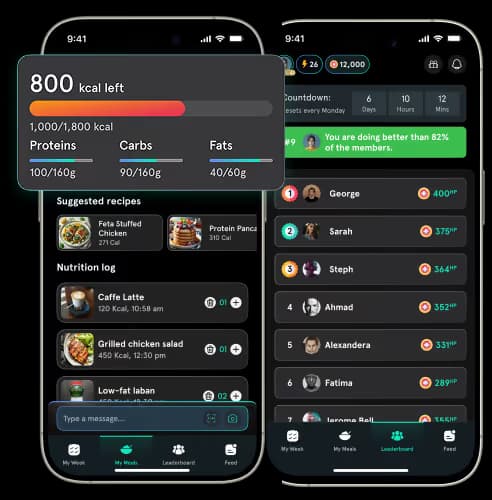
Manually calculating your weekly sets across different days often leads to mathematical errors and chronic undertraining. Trainmate's AI workout planner tracks your weekly volume per muscle group automatically, so you always know exactly when your quadriceps have hit the targeted 14-set threshold for optimal growth. You must only count working sets taken within 1 to 3 repetitions of absolute muscular failure toward this weekly total, as sets ending far from failure generate insufficient metabolic stress to force adaptation.
As you progress from an intermediate to an advanced trainee, your volume requirements will increase to disrupt homeostasis. You should start at the lower end of the volume landmark, executing 10 hard sets per muscle group per week, and slowly add one set every two weeks as your recovery capacity improves. When you reach 20 sets and find yourself unable to recover before the next session, you must initiate a deload week to dissipate accumulated fatigue.
Muscle Building Routine for Beginners: Translating Theory into Practice
Executing a muscle building routine for beginners demands a focus on technical proficiency over absolute load. You must select 4 to 6 exercises per session and execute them with perfect form, utilizing a controlled eccentric (lowering) phase lasting two seconds. The core of your routine should rely heavily on free weight compound movements such as squats, deadlifts, barbell rows, and overhead presses to recruit the maximum number of motor units simultaneously.
Maintaining progressive overload remains the single non-negotiable variable for muscle gain over long time horizons. Trainmate's step tracking and workout logging system adapts your prescribed weights based on your previous performance, ensuring your mechanical tension increases systematically week over week. If you bench pressed 135 pounds for 3 sets of 8 reps last week, you must aim for 3 sets of 9 reps or increase the load to 140 pounds during your next session to force new growth.
To guarantee adherence, you should schedule your workouts at the exact same time each day to build an unbreakable routine. You can drastically improve your consistency by utilizing habit stacking techniques, such as packing your gym bag immediately after finishing dinner the night before. Removing daily decision fatigue allows you to channel your mental energy entirely into the physical exertion required for hypertrophy.
Optimizing Recovery and Sleep for Adaptation
Muscle tissue is broken down in the gym but constructed exclusively during deep sleep and rest periods. You must consume 0.7 to 1 gram of protein per pound of body weight daily to provide the amino acids necessary for repairing micro-tears in your muscle fibers. Pairing this protein intake with a slight caloric surplus of 200 to 300 calories creates the anabolic environment required for building substantial mass over several months.
Sleep dictates your hormonal profile, directly impacting your testosterone, cortisol, and human growth hormone levels. You must secure 7 to 9 hours of quality sleep per night to optimize sleep for muscle recovery and prevent chronic systemic inflammation. Lifters who sleep less than 6 hours per night experience a 15% reduction in protein synthesis, effectively sabotaging the hard work they executed in the weight room.
Quick-Start Implementation Checklist
- Assess your realistic weekly schedule to determine if you can sustainably execute a 3, 4, or 5-day training split.
- Select one primary compound movement for each major muscle group to serve as the foundation of your heavy lifting.
- Assign 2 to 3 isolation exercises per muscle group to ensure complete structural development and target lagging areas.
- Calculate your initial volume by scheduling exactly 10 working sets per muscle group per week to establish a baseline.
- Track every set, rep, and weight lifted in a dedicated logbook or application to guarantee you are forcing progressive overload.
Frequently Asked Questions
How many days a week should I work out to build muscle?
You should train between three and five days per week to maximize muscle growth. This frequency allows you to hit every major muscle group twice weekly while ensuring your central nervous system recovers fully. Training fewer days requires exhausting sessions, while training six days often leads to systemic overtraining.
How long should a hypertrophy workout last?
A scientifically structured hypertrophy workout requires 45 to 75 minutes to complete. This timeframe allows for 15 to 25 total working sets and adequate rest periods of two to three minutes between compound exercises. Training beyond 90 minutes typically diminishes intensity and elevates cortisol, negatively impacting muscle recovery.
What is the optimal repetition range for muscle gain?
The optimal rep range for muscle gain spans from 6 to 15 repetitions per set. Heavy compound movements benefit from the 6 to 8 range to maximize mechanical tension. Isolation exercises respond best to 10 to 15 reps to accumulate metabolic stress without causing excessive wear on connective tissues.
Should I perform cardiovascular exercise on my rest days?
You can perform light cardiovascular exercise on rest days, provided you keep your heart rate in zone two. Walking or relaxed cycling improves blood flow and nutrient delivery to recovering muscle tissues. Avoid high-intensity interval training on your designated rest days, as it disrupts the local recovery necessary for hypertrophy.
How frequently should I change my workout plan?
You must stick to the same workout plan for 8 to 12 weeks to observe measurable hypertrophic adaptations. Changing exercises every week prevents you from mastering motor patterns and applying progressive overload effectively. Only substitute an exercise when you experience joint pain or plateau completely on your working weights.
Executing Your Hypertrophy Strategy: Next Steps
Building substantial lean mass is a predictable physiological outcome when you apply the correct stimulus over an extended timeframe. You now possess the exact framework needed to design a weekly workout plan for muscle gain that aligns with evidence-based volume targets and frequency models. Your immediate next step is to lock in your training days, select your primary compound lifts, and commit to tracking your numbers meticulously for the next twelve weeks.
Achieving your hypertrophy goals requires removing friction from your programming and focusing entirely on execution in the gym. Trainmate's AI workout planner builds this exact scientifically-backed split for you automatically based on your available days and specific structural goals. Download Trainmate today to generate your personalized muscle-building program and start logging your sets directly in the app.