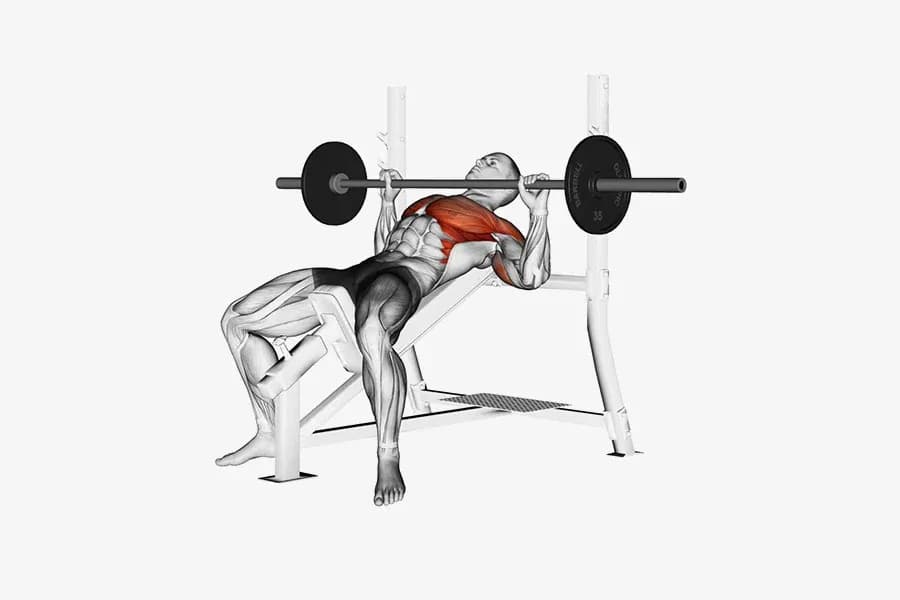
Muscles Targeted
The Benefits of the Close Grip Bench Press
Close-grip bench presses are a popular movement for overloading and strengthening the triceps. The objective is to have your hands close while gripping the barbell. In contrast, a wide-grip bench press forces you to keep your hands far from one another, leading to better chest activation.
The most notable benefit of the close-grip press is that you overload and strengthen your triceps, leading to more growth and improved lockout strength.
Another advantage of the movement is that it teaches you to press without flaring your elbows. The skill comes in handy when using a wider grip to target your chest because it protects your shoulders and improves your pressing strength.
We recommend including the close-grip press early in your training, ideally in the first or second session. Start with less weight than you use on a traditional bench press, do each repetition with a full range of motion, and perform at least eight reps per set.
How to do a Close-Grip Bench Press
- Set the barbell at a height where you can reach it from a lying position without extending your elbows fully.
- Lie on the bench and position your head directly underneath the bar.
- Reach up and grab the bar with an even, overhand grip. Your hands should be shoulder-width apart. Envelop the barbell with your thumbs for extra security.
- Bring your shoulder blades back and draw your feet back and toward the bench, digging the balls of your feet into the floor.
- Engage your body, take a breath, and unrack the bar by extending your elbows.
- Bring the barbell over your chest and take another breath.
- Lower the barbell to your upper stomach, tap it, and press the bar up, bringing it over your chest again. Exhale near the top.
- Once finished, bring the barbell over the rack slowly and rest it gently.
Close Grip Bench Press Muscles Worked
Our triceps are the primary muscle group involved in the close-grip bench press (1). The muscle covers the rear of our upper arms, and its primary function is elbow extension (straightening of the arm), which occurs as we press the barbell from the bottom (2).
As briefly mentioned above, a closer grip on the bar puts the triceps at a mechanical advantage, forcing the muscle to produce most of the force necessary to move the weight.
The pectoralis major (chest) is the second muscle group with an active role during the close-grip press (1, 3). Our pecs cover the upper front half of the torso and assist the triceps with pressing the weight from the bottom. The muscle group also works as we lower the barbell, controlling it on the way down.
Our shoulders (deltoids) also contribute to the bench press (4). The muscle’s primary function is to stabilize the shoulder joint, and the anterior deltoid head assists the chest and triceps with pressing the weight.
Aside from the above muscles, our midsection and upper back contribute during the bench press. The back keeps our shoulder blades retracted, and the core promotes stability.
Tips on the Close Grip Barbell Bench Press
The first consideration for effective close-grip pressing is to have your hands shoulder-width apart. Trainees often bring their hands closer, but doing so only increases the risk of wrist discomfort. In contrast, a shoulder-width grip puts your triceps at a mechanical advantage while keeping your joints in a safe position.
Our second tip for the close-grip press is to start with a lighter weight and perform each rep through a full range of motion. Doing so is beneficial for engaging your triceps well on every repetition.
The third thing to keep in mind for the movement is to retract your shoulder blades and dig them into the bench before unracking the barbell. That way, you can create a solid base to press from and keep your shoulders in a safe position.
Our final suggestion for the exercise is to lower the bar to your upper stomach. Doing so is beneficial for keeping your wrists and elbows aligned while also reducing the risk of elbow flare.
How to Do Barbell Bench Press
- 1
Set the barbell at a height where you can reach it from a lying position without extending your elbows fully.
- 2
Lie on the bench and position your head directly underneath the bar.
Common Mistakes to Avoid
- ✕Must have a spotter
Do This Exercise in TrainMate
Get real-time coaching, rep tracking, and form guidance — powered by AI.
Open in TrainMate